Gas Cylinder Storage in the Workplace: Rules and Safety
Storing gas cylinders in the workplace is a critical issue for many sectors, including industry, logistics, production, maintenance and packaging. Poor management can lead to serious risks for people, buildings and goods. That is why it is essential to follow strict rules and adopt appropriate practices.
At RIPACK, specialists in industrial shrink-wrapping solutions, we support companies in the safe and sustainable use of gas cylinders.
Why is gas cylinder storage regulated?
Gas cylinders contain compressed or liquefied gases, often flammable such as propane or butane. Therefore, constant vigilance is required.
This is why regulations require:
clear identification of cylinders,
specific storage conditions,
appropriate staff training.
These requirements aim to reduce risks and protect employees in the workplace.
Identifying the type of gas stored
Before any storage operation, it is essential to accurately identify the type of gas:
flammable gases,
pressurized gases,
industrial or technical gases.
Each category has specific constraints. For example, gases heavier than air, such as propane, must never be stored in basements, as they can accumulate at ground level and create an explosive atmosphere.
Choosing a safe storage location
A suitable and ventilated area
Gas cylinders must be stored in:
a well-ventilated area, either natural or mechanical,
away from any source of heat, flame or sparks,
protected from weather conditions and impacts.
Whenever possible, outdoor storage or storage in a dedicated room is strongly recommended.
A clearly marked area
The storage area must be:
clearly identified with visible signage,
equipped with “No Smoking” signs,
accessible only to authorized personnel.
Positioning and securing gas cylinders
Gas cylinders must always be:
stored upright, with the valve facing upwards,
stored without a regulator fitted,
secured using suitable supports, chains or racks.
This positioning prevents the release of liquid gas and significantly reduces the risk of accidents in the event of a leak.
Separating full and empty cylinders
An empty cylinder may still contain residual gas. It is therefore essential to:
store empty cylinders in a separate area,
handle them with the same precautions as full cylinders,
organize their return to the supplier according to established procedures.
Clear flow management improves both safety and logistical organization.
Training teams and securing handling operations
Safety also depends on users. Anyone required to handle gas cylinders must be trained in:
storage rules,
safe handling practices,
procedures to follow in the event of an incident.
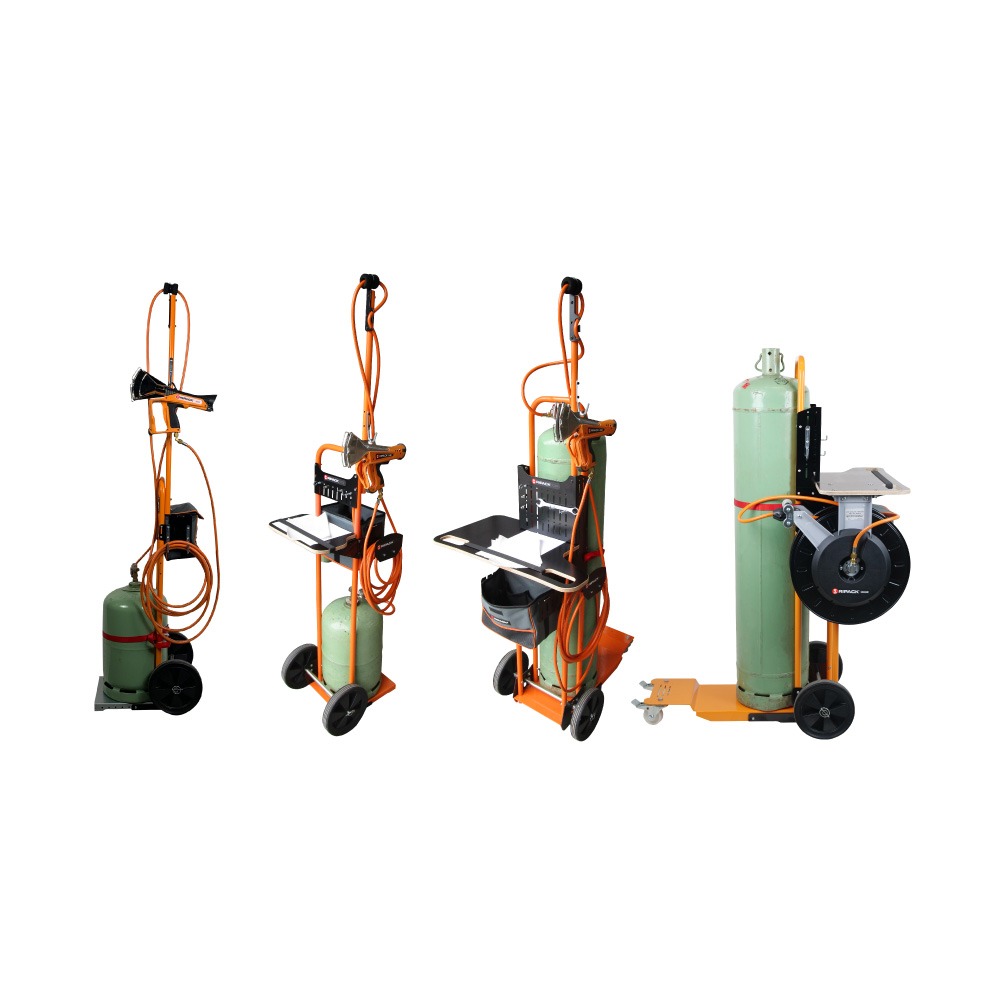
The use of personal protective equipment (gloves, safety shoes) is essential, as is the use of cylinder trolleys to prevent falls and excessive physical effort. RIPACK trolleys are robust and specially designed to safely transport gas cylinders and shrink guns, turning your equipment into an ergonomic mobile workstation. They make movement within the workshop easier, protect the hose and regulator thanks to integrated guides, and keep tools within easy reach (storage bag, shelf, modular hooks depending on the model), improving safety, comfort and productivity. Discover our four different trolley models, available in push or pull versions. Models 936 and 936+ can carry 40 kg cylinders, while models 932 and 932+ can accommodate cylinders weighing up to 70 kg.
Conclusion
Gas cylinder storage in the workplace should never be overlooked. By complying with safety rules, training teams and choosing appropriate solutions, companies reduce risks while improving their organization.
Whether you are sending one-off items or large quantities on a daily basis, Ripack has the solution to meet your needs for protecting your goods in shrink film. Tell us what you need and we’ll point you in the right direction.
Newsour latest news
29Jan2026Gas Cylinder Storage in the Workplace: Rules and Safety
Storing gas cylinders in the workplace is a critical issue for many sectors, including industry, logistics, production, maintenance and packaging. Poor management can lead to serious risks for people, buildings and goods. That is why it is essential to follow strict rules and adopt appropriate practices. At RIPACK, specialists in industrial shrink-wrapping solutions, we support […]
22Dec2025Ripack: A Year Shaped by Connections, Commitment, and the Circular Economy
The year coming to an end has been particularly intense for Ripack. More than ever, our teams have been out in the field, close to industry professionals, to connect, learn, showcase our solutions, and support our partners. Driven by the desire to move forward together, this momentum has been the guiding thread of a year […]
24Nov20255 common mistakes when shrink-wrapping… and how to avoid them
Shrink-wrapping with film is a simple and effective solution to protect pallets, machines, boats or worksites. But like any thermal process, a few bad habits can quickly waste time, damage the film… or even create holes. Here are 5 very common mistakes we see in the field, and more importantly, how to avoid them. 1. […]
15Oct2025The 3 Essential Accessories to Optimize Your Shrink-Wrapping Station
Un poste de rétraction performant ne dépend pas uniquement du pistolet de rétraction. Pour obtenir un travail plus rapide, plus confortable et surtout plus sûr, il est essentiel de s’équiper des bons accessoires. Chez Ripack®, chaque détail compte pour garantir la performance, la sécurité et la durabilité de vos opérations d’emballage. Découvrez les 3 accessoires […]
To provide the best experiences, we use technologies such as cookies to store and/or access device information. Consenting to these technologies will allow us to process data such as browsing behaviour or unique IDs on this site. Failure to consent or withdraw consent may adversely affect certain features and functions.
Functional
Always active
The storage or technical access is strictly necessary for the legitimate purpose of enabling the use of a specific service explicitly requested by the subscriber or user, or for the sole purpose of carrying out the transmission of a communication over an electronic communications network.
Preferences
The storage or technical access is necessary for the legitimate interest purpose of storing preferences that are not requested by the subscriber or user.
Statistics
Storage or technical access that is used exclusively for statistical purposes.Technical storage or access which is used exclusively for anonymous statistical purposes. In the absence of a subpoena, voluntary compliance by your internet service provider or additional third party records, the information stored or retrieved for this sole purpose generally cannot be used to identify you.
Marketing
The storage or technical access is necessary to create user profiles in order to send advertisements, or to track the user on a website or on several websites with similar marketing purposes.