

Written by:
Updated on:
Reading time:
Table of contents
- Essential protection between two seasons
- An envelope perfectly tailored to each boat
- The Ripack heat gun and its extension, at the heart of the operation
- Preparation that makes all the difference
- Protection designed to last
- The benefits observed during this operation
- A solution adapted to many marine professionals
- The applicator’s expertise, a decisive factor
Case study: heat-shrink boat packaging, looking back at a winterizing operation carried out in France
Essential protection between two seasons
Once out of the water, a boat can remain immobilized for several weeks or even months in a shipyard, dry stack, or storage area. During this period, however, it continues to suffer the effects of its environment.
Rain, wind, UV radiation, dust, leaves, bird droppings, and salt spray gradually degrade the exterior condition of the vessel. Condensation cycles caused by temperature variations can also promote the appearance of moisture in equipment or interior furnishings.
The constraints are similar when transporting a new boat between its manufacturing shipyard and its dealer. At high speed, road debris, insects, gravel, or friction caused by the wind can quickly damage a freshly prepared hull.
It is precisely in this context that ALG Emballage intervened to carry out complete heat-shrink containment of several units, relying on Ripack shrink-wrapping equipment.
In summary :
Road transport, outdoor storage, extended winter storage… Boats are exposed to numerous aggressive elements once they leave the water. To ensure their protection until they are returned to service, the use of heat-shrink packaging is now a benchmark in the nautical sector. A look back at an operation carried out in France by ALG Emballage, a distributor of Ripack solutions, on several vessels intended for transport and storage.
An envelope perfectly tailored to each boat
Unlike a traditional tarpaulin simply secured with straps, heat-shrink packaging involves creating a true second skin around the vessel.
After preparing the boat and installing the necessary protections on sensitive areas, operators apply a technical polyethylene film specially designed for marine applications. The film is then welded to form a continuous envelope, and then progressively shrunk using a Ripack heat gun. The heat causes uniform tension in the material, which accurately matches the shapes of the hull, deck, superstructures, and equipment.
The result is a homogeneous, perfectly tensioned protection, with no flapping in the wind and no pockets likely to pool water.
The Ripack heat gun and its extension, at the heart of the operation
Shrink-wrapping determines the overall result, and this is the phase that places the greatest demand on the tools: several hours of continuous heating per unit, over dozens of square meters of film.
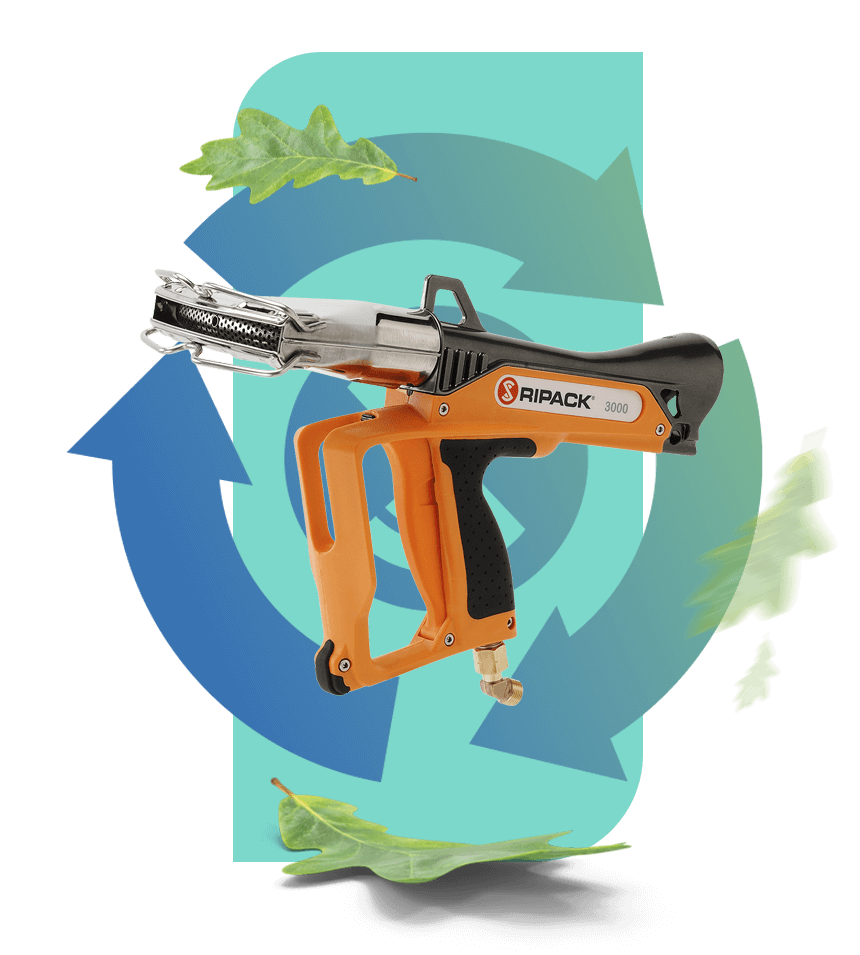
The operation was carried out using a gas-powered Ripack 3000 heat gun. On the outdoor storage yard, with no electrical power supply near the boat, this autonomy allows the operator to move freely around the hull without cables or extension cords to move.
Height, on the other hand, is handled using an extension. A boat on cradles quickly puts the deck, cabin top, or the top of the framework supporting the film out of reach of an operator on the ground. Rather than multiplying means of access at height, the heat gun is fitted with a tube inserted between the handle and the nozzle. The operator reaches the upper parts from the ground, works large surfaces in long, continuous passes, and keeps the flame clearly away from the body.
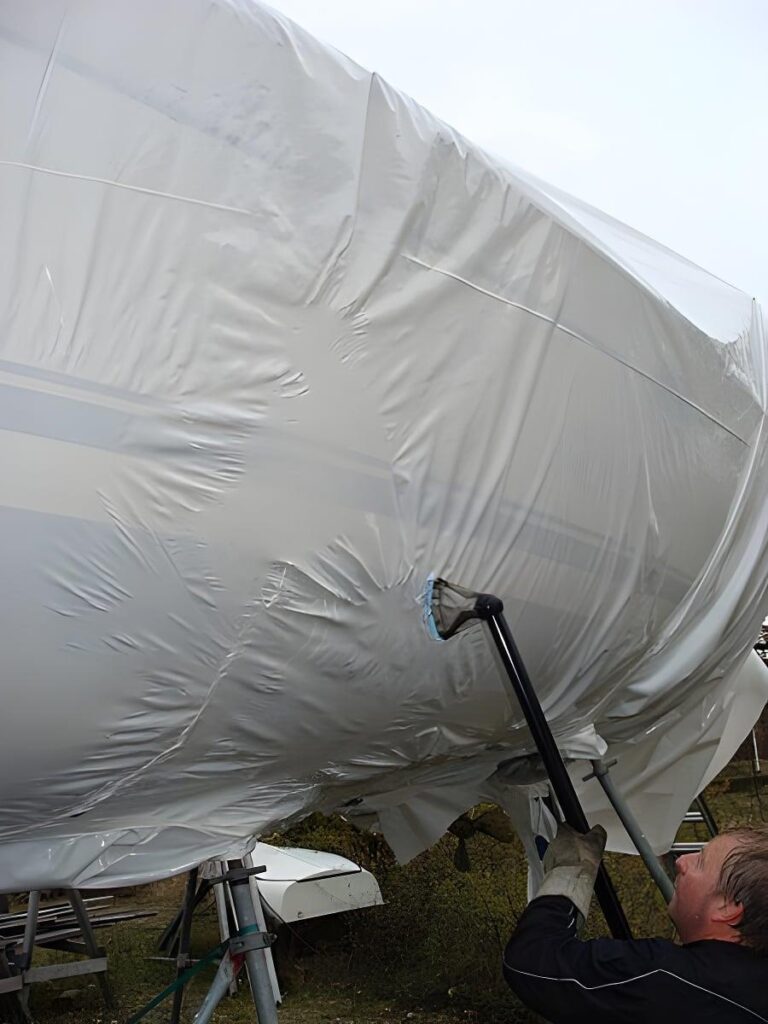
Photo: ALG Emballage.
The extension moves the nozzle away from the operator, not from the film: the heating distance remains the same, but it is controlled at arm’s length, with a greater leverage arm and more distant visual feedback. Hence an alternation of configurations depending on the area. Extension for heights and large surfaces, bare heat gun for finishing touches: sharp angles, sheet joints, contours of the access door and vents.
Properly adjusted and held correctly, the tool shrinks without marking the film. If poorly controlled, it punctures or weakens the envelope on the most exposed part of the boat.
On this job, the distribution of configurations was as follows:
| Treated area | Gun configuration | Why |
| Deck, cabin top, top of the framework | With extension | Reach upper parts from the ground, without elevated access equipment |
| Large flank surfaces | With extension | Long and continuous passes, even heating over large surfaces |
| Sharp angles, sheet joints | Without extension | Short and precise movement, localized heating |
| Access door, vents | Without extension | Fine control to avoid puncturing or weakening the film |
Preparation that makes all the difference
On this type of operation, the quality of the result does not depend solely on the film used or the shrink-wrapping tool. Before any shrinking operation, several preparation steps are carried out:
- protection of sharp edges and sensitive equipment;
- creation of a framework when certain volumes require clearance under the film;
- welding of the various sheets to obtain a continuous envelope;
- installation of accessories before the final shrink-wrapping phase.
This preparation makes it possible to obtain packaging perfectly adapted to the dimensions of each boat while guaranteeing excellent durability for several months.
Protection designed to last
The film used benefits from an anti-UV treatment allowing prolonged outdoor exposure without significant loss of its mechanical performance.
Vents are integrated into the packaging to ensure natural air circulation and prevent condensation, and a zippered door maintains access to the boat throughout storage without having to cut or replace the envelope.
The benefits observed during this operation
- complete protection against rain, wind, snow, spray, and dust;
- perfectly tensioned envelope without wind flapping, achieved by homogeneous shrinking with the Ripack heat gun;
- treatment of upper parts from the ground thanks to working with an extension;
- limitation of soiling throughout the duration of storage;
- excellent UV resistance for long-term winter storage;
- reduction of condensation risks thanks to integrated vents;
- facilitated access to the boat via a zippered door without damaging the protection;
- neat presentation particularly appreciated during the delivery of new boats.
Beyond the protective aspect, heat-shrink packaging also helps preserve the aesthetic value of the vessels until they are put into service or relaunched.
A solution adapted to many marine professionals
Heat-shrink containment meets the needs of many industry stakeholders: shipyards, boat builders, dealers, rental companies, marinas, specialized transporters, and maintenance and winter storage companies.
Its versatility allows it to protect a unit for a few days of transport just as well as for several months of outdoor winter storage.
The applicator’s expertise, a decisive factor
While the performance of the film plays an essential role, the final quality depends above all on the tools selected and the mastery of their implementation. Choice of thickness, sizing of the framework, quality of the welds, gun configuration adapted to each zone, heating adjustment, and regularity of passes with the extension: each of these steps requires real field expertise.
This operation was carried out by ALG Emballage, a distributor of Ripack solutions, which supports professionals in the choice of shrink-wrapping equipment, extensions, and consumables, as well as in the implementation of heat-shrink protections adapted to the constraints of the nautical sector.
Share this article


Besoin d’informations, une question ?
Notre équipe dédiée vous répondra dans les plus brefs délais.


